- calendar_today August 14, 2025
.
Electric vehicle sales are slowing in the United States and now face fresh headwinds. After a year of month-over-month increases, EV sales have begun to decline. Consumer rejection has already been seen at Genesis and Volvo, with both automakers looking to downsize or discontinue their electric offerings.
President Biden’s administration has also not proven a friend to electrification, reducing subsidies and rolling back vehicle pollution standards, creating less support from the federal government. However, researchers have identified a major hurdle to EV adoption, and it’s not political but parked in the nation’s garages.
Concerns about charging infrastructure have long topped surveys on barriers to EV adoption. Market research firm Telemetry’s Vice President Sam Abuelsamid has released a study drilling into this concern, revealing a simple but often-overlooked detail: where people park in their garages.
Electric vehicle charging has gotten a lot of attention for rapidly expanding public fast-charging networks. However, most EV charging is still done at home. Charging data shows that about 80 percent of all EV charging is still conducted using AC power, with most taking place at a single-family dwelling. The National Renewable Energy Laboratory (NREL) estimated 42 percent of homes are currently parked near a receptacle suitable for level 2 (240-volt) charging.
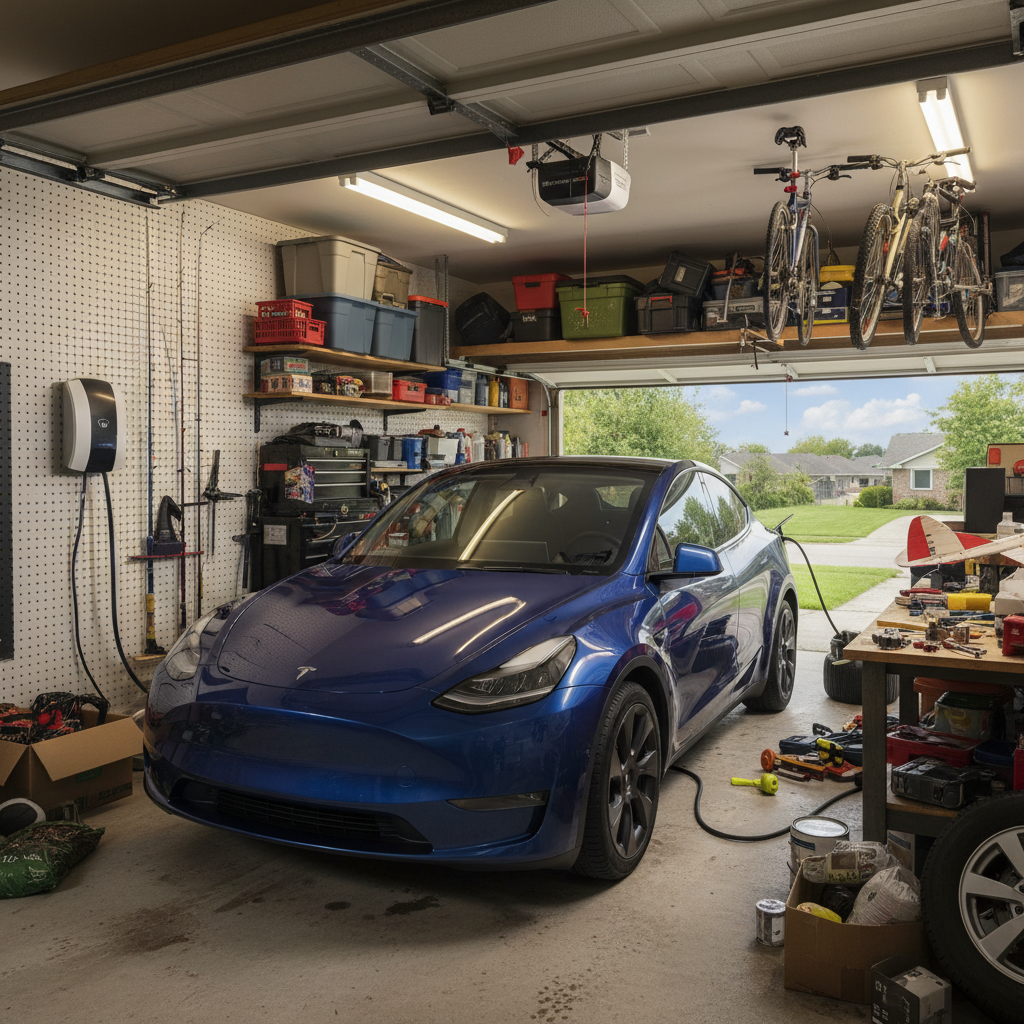
This number is likely to increase significantly as homeowners declutter their garages and adopt a few changes in parking behavior, the study’s author stated. “Parking behavior, namely whether homeowners use a private garage for parking or storage, will likely become a key factor in EV adoption,” Abuelsamid said.
Opening up more of these garages to vehicles rather than storage would increase the number of homes that can charge EVs from 31 million to over 50 million. Once homes where new wiring is required are factored in, the number of capable homes rises to over 72 million. This exceeds even the most bullish of Telemetry’s EV penetration scenarios by 2035, which forecast between 33 million and 57 million vehicles.
The number of garages that can accommodate an EV on paper is not the same as the number that can easily and affordably do so. NREL found that nearly 34 million homes would need some level of electrical upgrades before they could support a level 2 charger, which typically requires a 30 amp minimum. These upgrades, which can range from additional wiring to a whole panel replacement, can run homeowners thousands of dollars.
This changes the value proposition of EVs significantly. If the purchase and installation of charging hardware are included in the total cost of ownership, EVs’ long-term savings can easily be negated, making them more expensive than the gas-powered alternatives they are meant to displace.
The problem is even more pronounced for Americans in multifamily homes, who account for 23 percent of households. Apartments, condos, and townhomes make up this segment, in which charging infrastructure is owned by a landlord or HOA and individual EV owners rarely have the autonomy to install chargers on their own.
Costs here are often significantly higher. An owner of a co-op will first need a new electrical panel installed, potentially a multimillion-dollar project. Running wire from the parking space to a future charger location is additional work that can be expensive. Multi-family dwellers are also often ineligible for municipal or utility rebates and incentives for charging installation. This leaves them at the mercy of landlords, management companies, and co-op boards.
There are approximately 1 million EVs currently in multifamily housing, but just 11 percent are parked within range of a charging outlet. States are starting to require 20-25 percent of parking spaces in new developments to be EV-ready, but Telemetry estimates there will only be between 6.7 million and 11.4 million charging-capable spaces in multifamily units by 2035, far short of demand.
Given limitations to charging at home, public charging infrastructure will be key. Telemetry estimates that 11.7 million to 14.3 million EV drivers who own single-family homes will continue to use public charging in 2035. An additional 7.8 million to 8.1 million EV owners in multifamily residences will also rely on public charging.
In total, this will create a need for between 523,000 and 586,000 DC fast chargers, as well as between 1.5 million and 1.6 million level 2 chargers across the country. This comes as electrical generation and distribution is already under pressure from a construction boom of new AI data centers, potentially further slowing the deployment of large public charging sites.
If the last year has shown nothing else, optimism around EV adoption has not always translated into straightforward results in the U.S. While Telemetry found 72 million or more homes that could support EV charging, garage clutter, cost of electrical upgrades, and limitations of multifamily living could all pose roadblocks. Even with significant public charging infrastructure expansion, the demand for charging will likely outstrip the supply in the near future.
The future of EVs in the U.S. might be parked in homeowners’ garages as much as with government policy or automotive company decision-making.