- calendar_today August 20, 2025
.
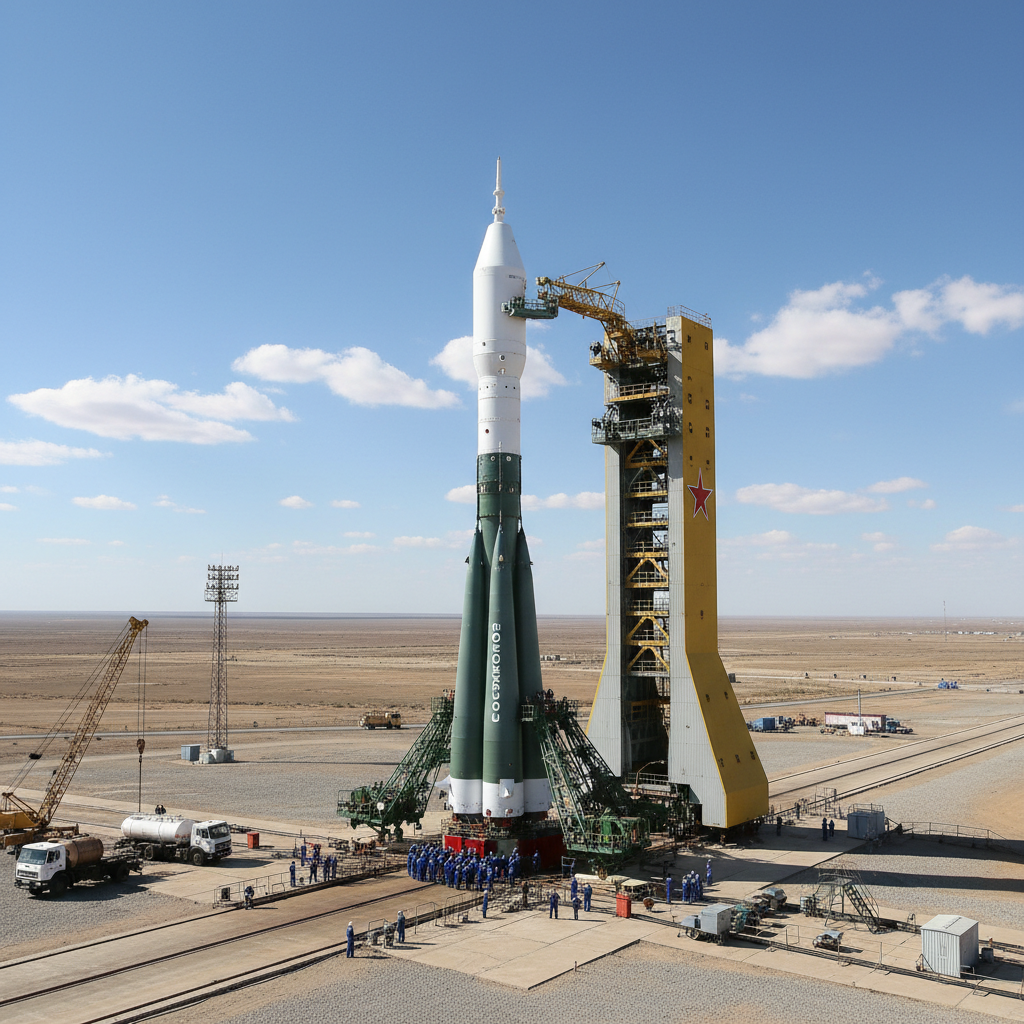
Russia is about to debut its latest rocket design before the end of this year. Dmitry Bakanov, the director of Roscosmos, told state-run news agency TASS in a recent interview that the Soyuz-5 is on schedule.
“Yes, we are planning for December,” Bakanov said. The preparations for the first liftoff are “basically complete,” he added. The launch will take place from the Baikonur spaceport in Kazakhstan. If all goes well, this will mark the first test flight of a rocket that took more than ten years to develop. Although Roscosmos is likely to conduct several trial launches, the vehicle won’t enter operational service until 2028.
Soyuz-5 is also known as Irtysh, a name that probably won’t surprise you if you’ve been following the ongoing history between Ukraine and Russia. As a rocket design, it’s not all that novel. In fact, many of the ideas for Irtysh have already been tried before in the Zenit-2 launcher.
Zenit first appeared in the late 1980s, the creation of Yuzhnoye Design Bureau in Ukraine. Even though the rockets were assembled in Ukraine, Zenit used Russia’s RD-171 engines. That made it one of the few launch vehicles that saw cooperation between Russia and Ukraine in the post-Soviet era. Moscow and Kyiv’s partnership, of course, came to a screeching halt after Russia’s 2022 invasion. Russia even bombed the Ukrainian plant where Zenits used to be assembled in late 2023.
It’s in that context that Soyuz-5 should be seen as a successor to Zenit. The former is a Zenit made in Russia, but also at a larger scale. It also means Ukraine is no longer part of the supply chain: all of Soyuz-5’s key elements will be homegrown. For Moscow, that independence is a victory—years of dependence are over, and Roscosmos can finally phase out the older Proton-M launcher at the same time.
A link to the past
Technically speaking, Soyuz-5 is a medium-lift rocket. It has a payload capacity of just over 17 metric tons to low-Earth orbit. That’s about a 20% performance boost over Zenit, a difference that’s been attributed to slightly larger propellant tanks. The rocket’s main engine, however, is the real showstopper: the RD-171MV.
The RD-171MV is the latest variant of an engine family with a long history. That design was first developed as part of the Energia program in the 1980s. It was the rocket that powered the Soviet Union’s short-lived space shuttle, Buran. The key difference of the RD-171MV is that it contains no Ukrainian parts at all. The engines are powered by kerosene and liquid oxygen and produce just over four million pounds of thrust. That’s over three times the power produced by NASA’s Space Shuttle main engine. It’s also the most powerful liquid-fueled rocket engine in operation.
Ironically, Soyuz-5 itself is an expendable rocket, despite being the product of a decade-plus development program. By comparison, its most prominent competitors are all designed with reusability in mind, SpaceX’s Falcon 9 among them. That fact alone has raised questions over whether Soyuz-5 will be able to gain a share of the international launch market at all.
That said, the rocket does serve an important role for Roscosmos. Russia’s space agency has had limited funding for new programs in the years since the war began, its budgetary hit from both war expenses and international sanctions. A brand-new, reusable rocket would be an almost impossible task to develop under those conditions. Amur, also known as Soyuz-7, was intended to fill that role. It has a reusable first stage and uses methane-fueled engines, which means it’s likely to have a low launch price point one day. The rocket could in theory compete with SpaceX. But those plans have been repeatedly delayed. Amur won’t fly until at least 2030.
Until then, it’s Soyuz-5 that bridges the gap between Russia’s past and future. For better or for worse, the country is still taking steps forward. The technology may be rooted in the Soviet era, but it’s at least still moving forward.
The commercial future is a lot more murky, however. The global launch industry has evolved over the last decade, with SpaceX and Chinese providers offering new and less expensive options. Russia has its Soyuz-2 rockets for crewed flights and its Angara family for heavier payloads, but neither has found much success abroad. Whether that changes with Soyuz-5 is an open question.
For the time being, Roscosmos seems to be content to keep doing what it’s been doing. Soyuz-5 is a stopgap measure, and it seems like it will stay that way until Amur finally enters service. With that in mind, there’s a lot riding on a successful launch in December. For Russia, it would be the latest proof that its space program can still put new hardware on the launch pad, even in the face of sanctions and a tightening budget.
For all its technical limitations, Soyuz-5 is more than just a bridge between Russia’s past and future. It’s also a statement of Russia’s current political and industrial reality. The fact that the rocket is here, and close to launch, is a testament to Russian ingenuity and perseverance in the face of incredible adversity.