- calendar_today August 24, 2025
The Sandman’s Farewell: A Faithful and Emotional Adaptation
The Sandman on Netflix has arrived for its second and final season. Season 1 was a mesmerizing adaptation of Gaiman’s boundary-pushing comics; it hit the tone of the source material perfectly while staying close enough to the plot to satisfy die-hard fans. While it had the episodic, anthology quality of the comics, the season also felt grounded by a strong central narrative: the arc of Dream, or Morpheus, throughout this period of his existence.
Netflix announced that Sandman would only receive two seasons in January, sparking a theory that they’d cut the second season in response to (unsubstantiated) accusations of sexual misconduct against the original creator, Neil Gaiman, which he has since strongly denied. On X, Heinberg stated that the network had always planned for two seasons and that the creative team thought they had “enough for two seasons, and no more.” As it turns out, they were right: Season 2 is a great continuation of the story.
Season 1 adapted Preludes and Nocturnes, The Doll’s House, and the bonus episodes “Dream of a Thousand Cats” and “Calliope” from Dream Country. Season 2, on the other hand, is based mostly on Seasons of Mists, Brief Lives, The Kindly Ones, and The Wake with significant contributions from Fables and Reflections (specifically “The Song of Orpheus” and a few portions of “Thermidor”) and the Newberry Medal-winning “A Midsummer Night’s Dream” from Dream Country. The second bonus episode adapted the 1993 one-shot spinoff Death: The High Cost of Living. A Game of You and some short stories are omitted; these events and characters aren’t essential to the overall arc of the Dream King, so that’s probably why.
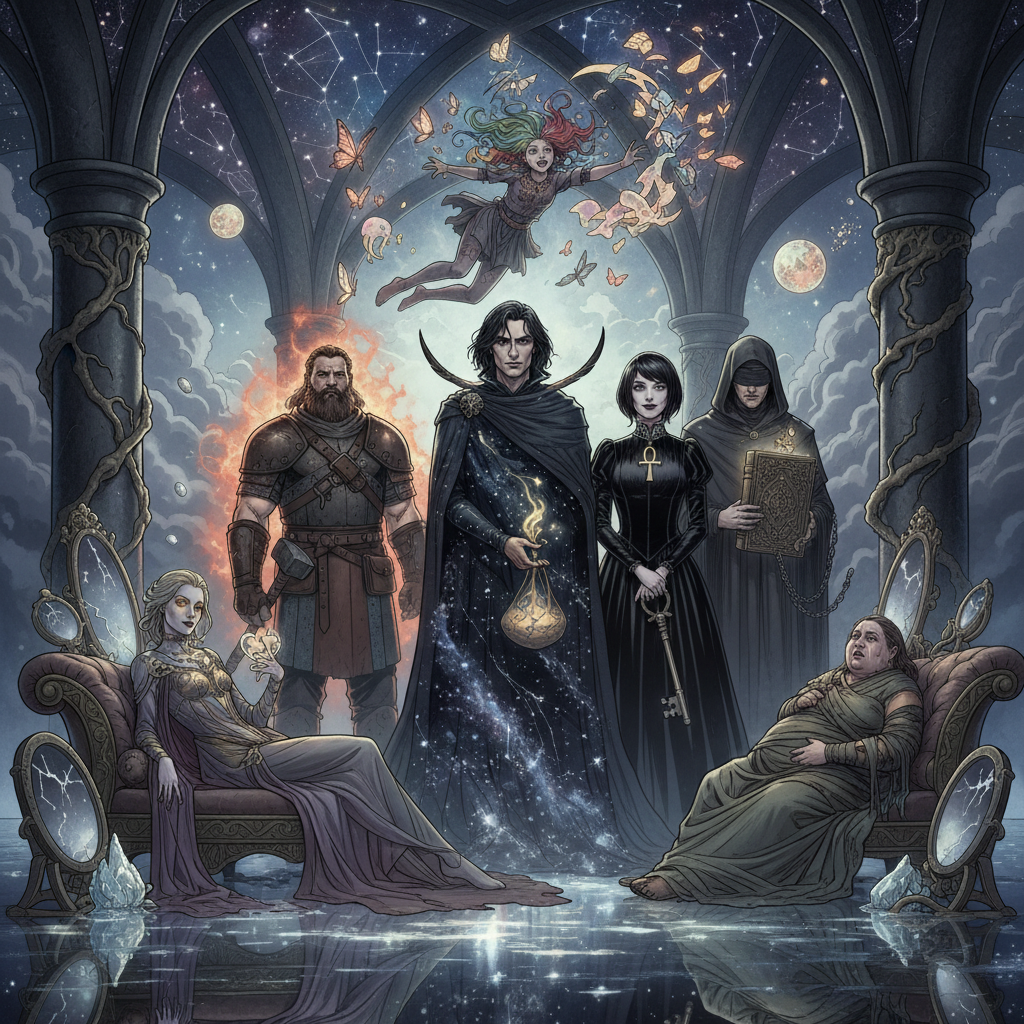
Season 1 ended with Dream having defeated all his enemies: escaped captivity, recovered his talismans, apprehended the wayward Corinthian (Boyd Holbrook), and averted the Vortex’s destruction. Dream, or Morpheus (Tom Sturridge), is hard at work on repairing and rebuilding the Dreaming at the beginning of Season 2; his labors are interrupted when his older sibling Destiny (Adrian Lester) appears to summon the rest of his family. This very unusual gesture results in Death (Kirby Howell-Baptiste), Desire (Mason Alexander Park), Despair (Donna Preston), and Delirium (Esmé Creed-Miles) assembling for a tense and awkward family pow-wow.
The meeting drives Morpheus on a rescue mission for Nada (Umulisa Gahiga), queen of the First People and his ex-lover, whom he cast into Hell. This pits him against Lucifer (Gwendolyn Christie) once more, who never forgave her defeat at the Dream King’s hands in Season 1. However, instead of a rematch, Lucifer resigns and gives him the keys to an empty Hell, with the understanding that he, Dream, is free to choose her replacement among the many petitioners, including Odin, Order, Chaos, and the demon Azazel.
Delirium’s search for her missing brother Destruction (Barry Sloane), who disappeared and abandoned his realm centuries prior, also pushes Morpheus further on his path to his predestined death: spilling the blood of family and incurring the vengeance of the Kindly Ones.
Highlights, Low Points, and a Satisfying End
The series continues to impress with high production values, including excellent casting and visual fidelity that matches the quality of the source material’s artwork. Sandman is beautiful to look at and immerses the viewer in Gaiman’s multilayered world. I have heard some viewers complaining that the series is slow-paced, but I did not find that to be an issue; in fact, I feel the pacing is deliberate and helps the audience sink into Gaiman’s mythos.
In my opinion, the low point of the season is the episode “Time and Night.” Morpheus seeks aid from his parents, Time (Rufus Sewell) and Night (Tanya Moodie), and the Endless are canonically his parents’ children. The dialogue is some of the worst in the entire season (even Sewell cannot entirely rise above some of the clunkier dialogue), and the interaction comes off as an extended therapy session rather than epic mythological high drama.
The highlights of the second season are numerous: Lucifer, now with wings, asking Dream to cut them off so that she can be fully human; the goddess Ishtar (Amber Rose Revah) casting off the trappings of her office to dance naked one last time as a goddess; Dream explaining to William Shakespeare (Sanjeev Bhaskar) why he must pen The Tempest; and a reformed Corinthian developing a crush on Johanna Constantine (Jenna Coleman). Other memorable sequences include Orpheus singing a haunting lament in the Underworld to the waiting Eurydice; Dream’s act of mercy in killing his son; and the Furies obliterating Fiddler’s Green (Stephen Fry), Mervyn Pumpkinhead (Mark Hamill), and Abel (Asim Chaudhry) in a fit of rage.
Dream dies after taking Death’s hand one last time. He passes the mantle to his new incarnation, Daniel Hall (Jacob Anderson), the only human ever born and fully realized in the Dreaming. Daniel is disoriented, but his intelligence and resolve shine through even in his earliest scenes. Morpheus’ Endless siblings grieve him and welcome Daniel, the latest Dream, into their number.
Bonus Episode
The series coda, the second bonus episode, sees Death spend a day as a human every hundred years; at the end of her time, she always dies. “It just goes so fast,” she says, smiling. “You want to hang onto every second. And you’d give anything for just one more.” The entire episode centers on her intervening in the life of a suicidal young man (Colin Morgan), and his near-death experience spurs him to reclaim his will to live. It is a nice end for the series, harkening back to Gaiman’s original concept for his masterpiece: a book about death with an underlying message of hope.