- calendar_today August 16, 2025
.
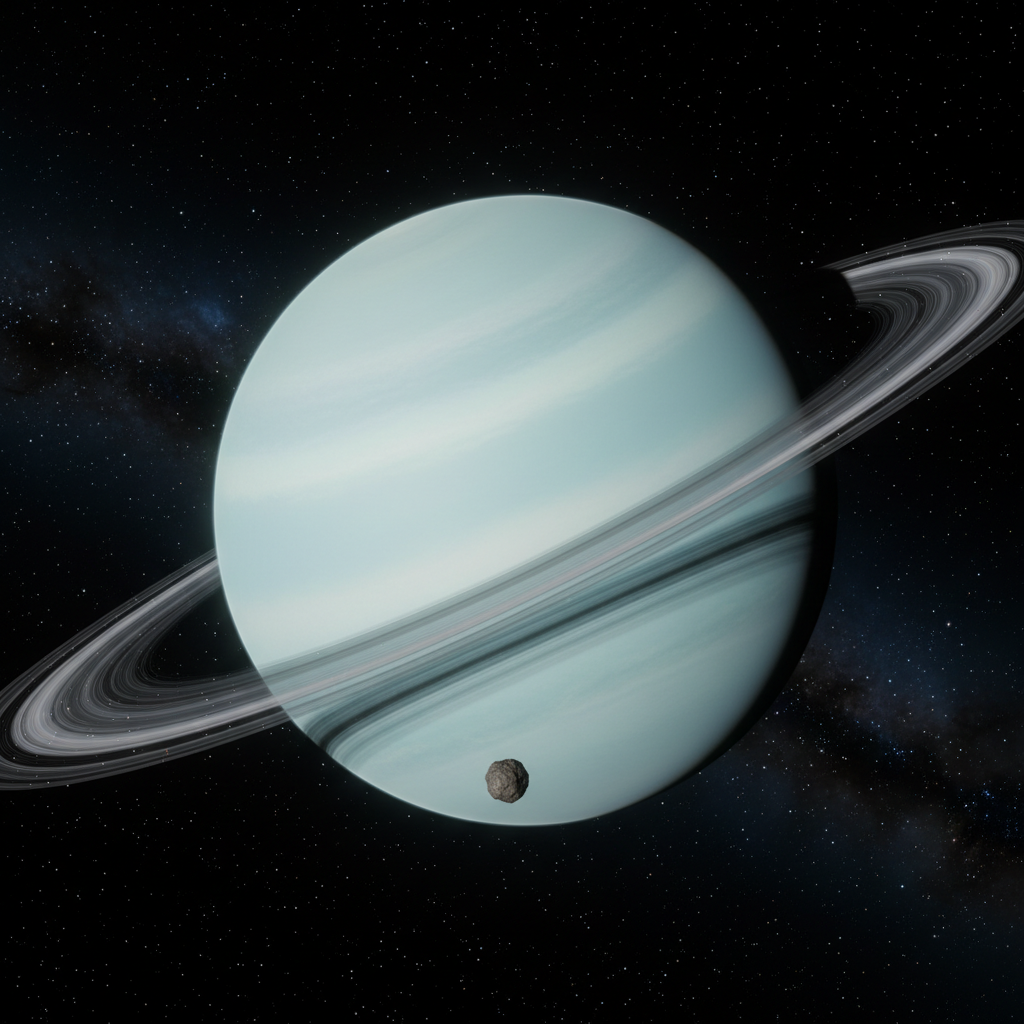
The James Webb Space Telescope (JWST) has found a previously unseen moon circling Uranus, the ice giant in the outer solar system known for its unusual axis tilt. It’s one of the planet’s known 29 moons; scientists suspect more remain hidden.
Webb’s astronomers first glimpsed the object on February 2 in a series of 40-minute-long exposure images. The Near-Infrared Camera on Webb, which is sensitive to the infrared light emitted by warm objects in space, revealed the dark, Jupiter-sized object lurking just beyond Uranus’ prominent ring system.
The new moon is only 6 miles (10 kilometers) across and, like all of Uranus’ moons, orbits the planet in the equatorial plane. The new object, currently known only as S/2025 U1, orbits Uranus about 35,000 miles (56,000 kilometers) from the planet’s center, between the known moons Ophelia, just beyond the main ring system, and Bianca.
Webb scientist Maryame El Moutamid, a lead scientist at the Southwest Research Institute’s Solar System Science and Exploration Division in Boulder, Colorado, is also principal investigator on a Webb program that is studying Uranus’ rings and inner moons. She announced the new moon’s discovery today, March 27, at the 2025 Lunar and Planetary Science Conference in The Woodlands, Texas.
“The moon is small, but the discovery is a big one,” El Moutamid said. “Webb is enabling us to see far beyond what was previously possible with spacecraft and telescopes, and this discovery will help us to understand the enigmatic and complex system of Uranus much better.”
Hints of Rings, Weather, and Atmosphere Already Seen
The Webb team announced its first views of Uranus’ rings, weather, and atmospheric conditions in May, and this discovery is a follow-up to that work. They find this moon difficult to tease out from the bright glare of the planet and its rings because it is dark, tiny, and moves quickly across the sky. Webb is the first telescope that can see such faint infrared light.
For instance, it detected five other small inner moons —Bianca, Cressida, Desdemona, Juliet, and Portia, each 8 to 10 miles (12 to 16 km) across—in addition to the one announced today. Uranus’ major moons are Miranda, Ariel, Umbriel, Titania, and Oberon. The newfound object is the 14th small moon in the inner system. No other planet has so many small inner moons close to each other. Astronomers are still trying to figure out how they all stay so close together, including the reasons for the high numbers of those moons, when they are in danger of crossing orbits.
Scientists suspect the tiny S/2025 U1 moon and a chunk of Uranus’ rings have a common origin, perhaps coming from the same breaking event a long time ago. “The discovery raises questions about how many more small moons remain hidden around Uranus and how they affect the evolution of the rings,” said El Moutamid, principal investigator of the JWST program to observe Uranus and Neptune, which are known for their extensive rings. This research will continue Webb’s investigation into the mystery of Uranus’ rings. “The outer rings are very narrow,” El Moutamid noted. “The moons discovered by Webb may shepherd the rings in ways we have not yet realized.”
Questions Raised on Moons and Rings
Scott Sheppard, an astronomer at the Carnegie Institution for Science, not involved in this new study, said the discovery is “very exciting because the small object is so close to Uranus’ inner ring system,” which makes it likely to be related to the planet, and not a passing object that strayed into Uranus’ orbit. He also found it intriguing that Webb could see the object at all. “We have detected a moon that is less than 10 kilometers across, but it is at a distance of one million kilometers from Uranus, and Webb was sensitive enough to detect this little moon,” he said.
Their existence also blurs the line between what should be considered moons and what should be considered rings, explained SETI Institute co-principal investigator in the Webb Uranus project Matthew Tiscareno.
“The discovery also further shows that moons and rings are not entirely different things but instead have a complex relationship with each other,” Tiscareno said. “The complex inter-relationships between these objects hint at a chaotic history and evolution of Uranus’ moons and rings.”
Their work also found that the new object is smaller and fainter than the tiniest known Uranian inner moons. That, too, suggests there are more satellites out there, just waiting to be found.
Discovering moons around Uranus happened in fits and starts. Before the Voyager 2 spacecraft’s flyby of Uranus in 1986, only five moons, the big ones, were known, with the earliest moons having been discovered as far back as 1787. Voyager 2 discovered another 10, ranging in size from 16 to 96 miles (26 to 154 km) in diameter, during its historic flyby of the planet. Later, astronomers using ground-based telescopes and the Hubble Space Telescope found 13 other small moons, measuring between 8 and 10 miles (12 and 16 km) in diameter, that are even darker than asphalt. Inward-facing moons tend to be ice and rock, while the outer moons beyond Oberon are believed to be captured asteroids.
Possible Mission to Uranus Ahead
Mission scientists said this finding and others like it in the coming years may feed directly into an upcoming Uranus mission that NASA is considering for the next large planetary program, called Uranus Orbiter and Probe. The space agency published a planetary decadal survey from the National Academies of Sciences, Engineering, and Medicine in 2022 that ranked the mission for Uranus as the top priority.
The suggested Uranus Orbiter and Probe mission could lift off in the early 2030s and arrive at the planet at the end of the next decade. NASA is having a budget battle in Congress over how to fund missions and other projects, and has not announced the next large program. If the mission does proceed, it would study the planet’s tipped rotation and axis, its unusually complex magnetic field, the dynamics of its weather and climate, and explore for ice ocean worlds that might exist around some of its moons.
Additional small moons with sizes of a few kilometers likely await discovery, whether in long-exposure Webb imaging or by spacecraft, Sheppard said. El Moutamid and her team will continue to monitor the new object to further constrain its orbit and work to uncover even more hidden moons around Uranus.
“Discovering a new moon around Uranus not only helps us to better understand how this strange system formed but also will help us study the rings in more detail,” El Moutamid said. “The discovery also primes the pump for future Uranus missions such as NASA’s proposed Uranus Orbiter and Probe.”