- calendar_today August 12, 2025
.
Washington and New Delhi built what many called the most successful strategic partnership of the post–Cold War era over more than two decades. That relationship, which thrived through various presidential administrations in both countries, is in the midst of one of its most difficult tests after trust between the two countries has frayed over tariffs, oil, and global realignments.
“We’re in a situation in the U.S.-India relationship where the premises and assumptions of the last 25 years — that everybody worked very hard to build, including the president in his first term — have just come completely unraveled,” Evan Feigenbaum, a South Asia analyst at the Carnegie Endowment for International Peace, said. “The trust is gone.”
The relationship soured after U.S. President Donald Trump announced sweeping tariffs on Indian imports this year over New Delhi’s continued purchase of Russian crude oil despite the war in Ukraine. The initial 25 percent tariff, which is set to double to 50 percent on August 27, has not convinced India to change its purchasing practices. Instead, it has seemingly driven the country into the arms of Moscow — and even Beijing.
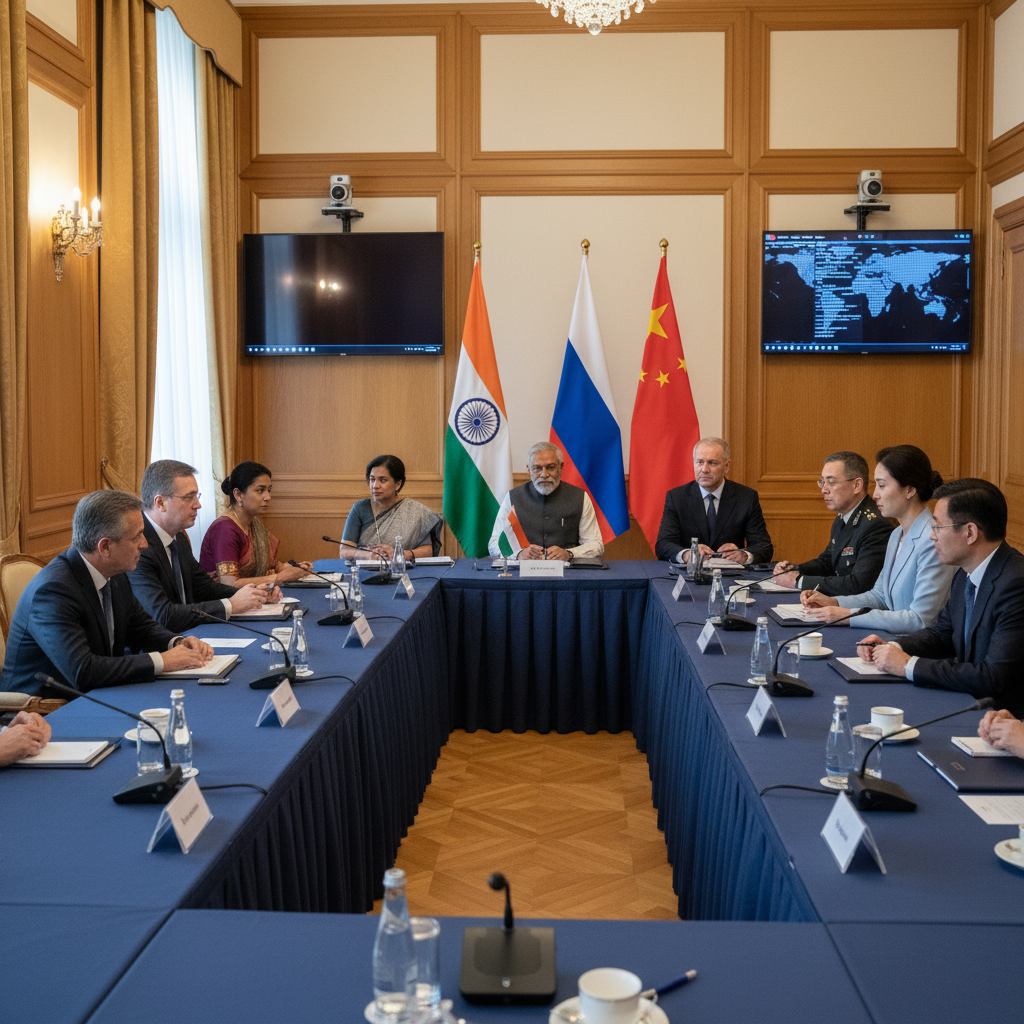
India’s national security adviser visited Moscow earlier this month, Foreign Minister Subrahmanyam Jaishankar met with his Russian counterpart, and Chinese Foreign Minister Wang Yi concluded talks in New Delhi last week. Prime Minister Narendra Modi is also expected to make his first trip to China in more than seven years in the coming months, and Russian President Vladimir Putin is expected to welcome him in Moscow before the end of the year. Analysts say the pivot to the east goes beyond optics.
Indian public opinion has also turned against what many view as U.S. interference in internal policy. “They’re signaling very clearly that they view that as interference in India’s foreign policy, and they are not going to put up with it,” Feigenbaum said.
After some early hesitation, state-run refiners began resuming Russian oil imports after discounts of six to seven percent. As a result, Russia now accounts for 35 percent of India’s crude imports, up from 0.2 percent before the Ukraine war. Moscow, smelling blood in the water, is doubling down. Deputy Prime Minister Denis Manturov said Russia would continue shipping crude oil, oil products, thermal and coking coal to India, and Russia’s gas industry has seen “potential for the export of Russian LNG.”
The Damage Done
“The U.S. is just one factor in the larger picture of India easing tensions with China,” said Michael Kugelman, a South Asia analyst in Washington. He noted that Trump’s tariffs are not the only cause of India’s diplomatic shift. “We’ve seen indications for almost a year of India wanting to ease tensions with China and strengthen relations, mainly for economic reasons. But the Trump administration’s policies have made India want to move even more quickly,” he said.
Some of New Delhi’s actions are likely meant to be performative, but others are far more substantive. Feigenbaum said, “India is going to double down on some aspects of its economic and defense relationship with Russia — and those parts are not performative.”
India had already been scaling back its dependence on Russian arms purchases before the Ukraine war, buying more from the United States, France, and Israel. Once the invasion began, however, trade in energy with Moscow surged. Kugelman put it bluntly: “India is being proved right in the belief that the U.S. can’t be trusted, whereas Russia can — because Russia is always going to be there for India no matter what.”
At the same time, Modi has been burnishing his credentials at home as a fierce champion of national sovereignty. He has made a point of speaking about his commitment to prioritizing the interests of farmers, small businesses, and young workers — a message with strong domestic political appeal. Kugelman pointed out that India has already given up a lot to Washington: tariff reductions and worker repatriation, for instance. “Because of those concessions, India needs to be careful about signaling further willingness to bend. This is one reason there was no trade deal — Modi put his foot down,” he said.
In the U.S. capital, frustration with India is growing. Peter Navarro, a former White House trade adviser, wrote in the Financial Times that India’s oil purchases are “opportunistic” and “deeply corrosive.” He argued that tariffs were a way to “strike India where it hurts — its access to U.S. markets — even as it seeks to cut off the financial lifeline it has extended to Russia’s war effort.”
A Dark Contrast
The current deterioration in relations is a far cry from the atmosphere surrounding key moments of the partnership’s rise. In 2008, the George W. Bush administration signed a civil nuclear deal with India that allowed it access to American fuel and technology even as it remained outside the Non-Proliferation Treaty. At that time, both governments were able to “compartmentalize” disagreements so they did not spill over into other areas of cooperation, according to Kugelman.
Today, the calculus is very different. The United States has long viewed India as one of the most important pillars of its democratic pushback to China in the Indo-Pacific strategy that has been a major priority for presidents Barack Obama, Trump, and now Joe Biden. But as fissures in the partnership leak from trade into defense and intelligence cooperation, that premise is coming into question.
“Countering China has been the glue binding this relationship,” Kugelman said. “But if the U.S.–India relationship continues this free fall, it will be very difficult to sustain.”
Feigenbaum sees the irony. “Then, India was leveraging its partnership to signal to then-foe China that it had options. Now they’re working with the Chinese to signal Washington rather than the other way around.”
The message from New Delhi is clear: India will do what it wants, even if that means cooperating more closely with America’s rivals.