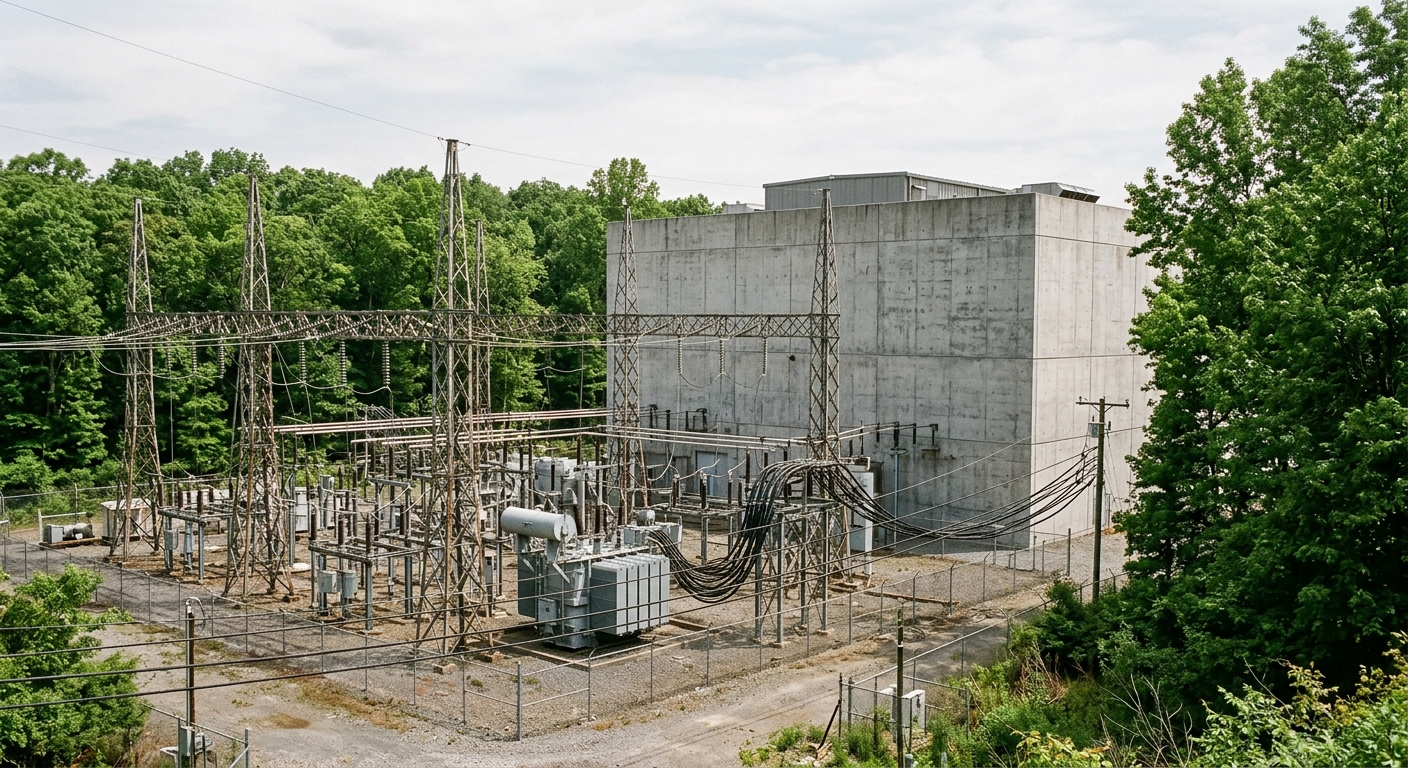
AI-generated illustration; not a photograph of the reported event.
- calendar_today October 14, 2026
America's Race to Build Data Centers Raises Grid Capacity Concerns
The rapid expansion of data centers, driven by artificial intelligence and Big Tech, is putting unprecedented pressure on the nation’s electric grid. Industry leaders and grid operators warn that power infrastructure may struggle to meet the surging power demand accompanying this technological growth.
Sharp Rise in Data Center Spending
According to an analysis of U.S. Census Bureau data by economist Jason Furman, private spending on data center construction soared about 64.5 percent (after inflation) from August 2025 to August 2026, reaching an annual rate of roughly $85 billion. While investment in building ai data centers accelerates, leaders in the electric grid sector caution that increases in power supply are moving more slowly.
Grid Operators Voice Concerns
Jim Matheson, CEO of the National Rural Electric Cooperative Association, noted that current grid capacity can generally meet existing power demand, but additional power plants will be needed as data center developments continue at a rapid pace. "If you want to go buy a gas turbine today, you can’t get one for 2032 because they’ve all been reserved," Matheson said, highlighting intense competition for natural gas infrastructure.
Christopher Johnson, president of the American Energy Leadership Institute, echoed these concerns, warning that access to electricity is likely to become the major constraint for new data center projects, especially in crowded markets over the next one to three years. He emphasized that areas able to add new power plants and grid connections fastest will attract the most investment.
Texas Illustrates Mounting Power Demand
Texas showcases the enormous scale of the challenge. The Electric Reliability Council of Texas (ERCOT) reported about 474 gigawatts of requests from large power users as of June 2026—roughly 90 percent attributed to data centers. By comparison, this figure is more than five times the state’s all-time peak demand. In response, ERCOT has paused new large data center connections pending a statewide audit and review of community impacts, as ordered by Governor Greg Abbott. Projects failing to meet state requirements may be denied connection to the grid, according to Abbott’s office.
Potential Risks for Power Utilities
Matheson also warned of financial risks for utilities investing in new infrastructure to support data center growth. "When you build a whole power plant to serve [a] 1,000 megawatt data center and the data center goes away, that’s a problem," he explained, since such plants are intended to run for decades.
Nationwide Impacts and Regional Disparities
The impacts extend beyond Texas. PJM Interconnection, the largest U.S. grid operator serving around 67 million people across 13 states and Washington, D.C., found data centers accounted for approximately $6.5 billion—about 40 percent—of the $16.4 billion price tag from its December 2025 power auction. However, a study released by the Data Center Coalition and consulting firm E3 found no historical evidence that data centers have caused residential electricity rates to rise. The study observed that while power demand increased sharply in states like Texas and Virginia, electricity rates climbed less than in other states where demand actually fell.
Utilities and Reform: Responding to the Challenge
Electric utility organizations are expanding their investments to keep up with data center growth and rising power demand. Drew Maloney, president and CEO of the Edison Electric Institute, emphasized the need to eliminate regulatory and market barriers to building new energy infrastructure. Meanwhile, industry experts like Johnson argue that clear and stable permitting rules are crucial to attracting new projects, warning that failure to expand supply in the face of growing demand could create affordability issues for consumers.
Private spending on power construction—spanning electricity as well as oil and gas projects—inched up by about 4.1 percent after inflation from August 2025 to August 2026, Furman’s analysis found. The slower rate compared to data center growth means new data centers may face delays waiting for electricity access. However, Furman cautioned that not every doubling of data center capacity requires a direct doubling of power plant construction.
Looking Ahead: Investment and Grid Expansion
Investor-owned utilities have gradually expanded their investments in energy infrastructure, with capital expenditures rising from about $104 billion in 2015 to $178 billion in 2024, according to Edison Electric Institute data. Projections indicate utility capital spending could surpass $220 billion in 2026 as the sector works to meet exploding demand from new data centers and other power users.
Source: tennesseestar.com.