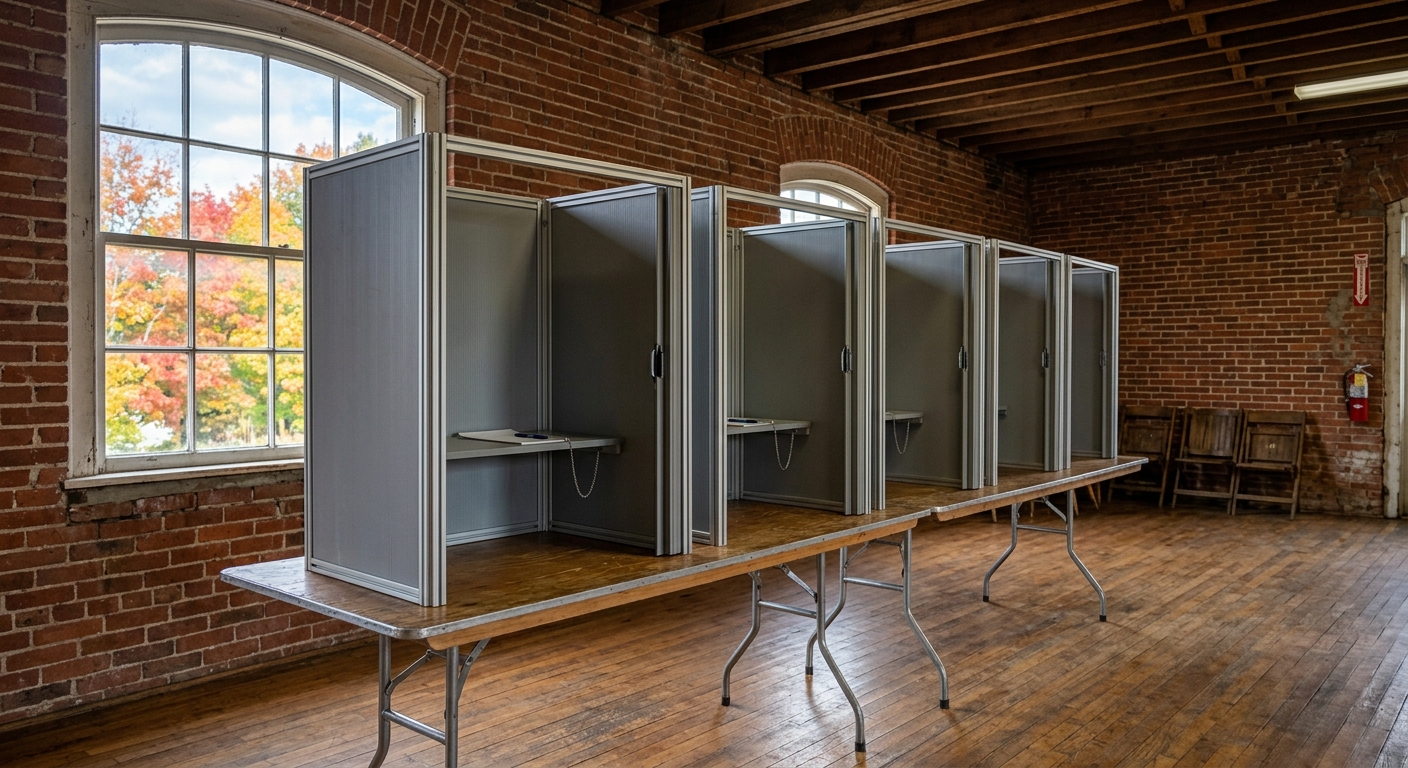
AI-generated illustration; not a photograph of the reported event.
- calendar_today October 13, 2026
Department of Homeland Security Addresses Concerns Over ICE Presence at Polling Locations
The U.S. Department of Homeland Security (DHS) has issued a statement clarifying that Immigration and Customs Enforcement (ICE) is not planning operations targeting polling locations ahead of the upcoming election. The announcement comes amid public discussion on election security, voter intimidation, and the appropriate presence of law enforcement at voting sites.
Concerns Raised Over Voter Access and Law Enforcement Presence
DaMareo Cooper, Executive Director of Popular Democracy, recently highlighted several pre-election concerns, including alleged gerrymandering in Tennessee, voter roll purges, and changes to voting locations in Georgia. Cooper emphasized that limiting opportunities for people to participate in elections could undermine access to the polls.
One specific issue raised by Cooper was the possible intimidation of voters if federal law enforcement, particularly ICE, were to be present at polling places. "I’m not saying that we should not secure those places and they should be safe, but if you see ICE agents, … they do not serve an electoral function, but if you see ICE agents at voter locations, that is an intimidation topic," he said. Cooper asserted that election security is traditionally handled by local and state law enforcement, not federal immigration enforcement agencies.
DHS Responds: No ICE Operations Targeting Polling Locations
Responding to these concerns, a DHS spokesperson stated to The Center Square via email that "ICE is not planning operations targeting polling locations." The spokesperson explained that ICE conducts intelligence-driven targeted enforcement actions, which are only employed if there is an active public safety threat that endangers a polling location. In such cases, targeted enforcement might result in arrests, but not as a matter of routine operation tied directly to the election process.
The spokesperson further clarified DHS’s role in elections: "The agency is fulfilling its obligation to protect election infrastructure under existing statutory authority so that our elections are fair, honest, and accurate." This reaffirms the agency’s responsibility for dhs election security rather than direct involvement in the electoral process at voting sites.
Voter Fraud Claims and the Role of Immigration Enforcement
The DHS spokesperson added that, together with the Department of Justice, they are "laser-focused on prosecuting and removing aliens who vote and preventing the dilution of the votes of U.S. citizens." They emphasized, "ONLY Americans should elect American leaders." Cooper, however, critiqued the emphasis on concerns about non-citizens voting, pointing out the rarity of such occurrences. "It’s point zero three percent probably across millions of voter registrations that that may be happening," Cooper said, arguing that the narrative could be used as a pretext for restrictive actions.
Federal and State Election Security Efforts
According to America.gov, the Help America Vote Act appropriated $15 million to states and territories for the fiscal year 2025 from Election Assistance Commission grants, a decrease from $55 million in fiscal year 2024 and $75 million in 2023 and 2022. Federal taxpayer funds also support state election infrastructure through the Homeland Security Grant Program, alongside technical assistance from the Cybersecurity and Infrastructure Security Agency.
Cooper insisted that local law enforcement remains adequate for protecting polling places. "I think local law enforcement has been securing elections for a hundred years in this country," he said. "There’s no need for federal officers to be at those locations. Local law enforcement, state law enforcement have done a good job of securing elections."
Voter Advice and the Ongoing Election Process
As early voting and mail-in ballots are already underway in states across the country, Cooper encouraged voters to ensure they are registered and to check the registration status of family members. "They should be checking to make sure that they’re registered to vote," Cooper advised. "They should make sure that their family members are registered to vote on their rolls. You could do that by calling your board of election."
With the general election set for November 3, DHS’s statement aims to provide clarity regarding the ice polling locations issue and reaffirm its commitment to protecting election infrastructure without engaging in actions that could be perceived as voter intimidation.
Source: tennesseestar.com.